
Comprehensive Artificial Intelligence (AI) In Transportation Market Report Covers Forecast, Innovations Industry Outlook
The Business Research Company’s Artificial Intelligence (AI) In Transportation Global Market Report 2026 – Market Size,
Press Release Disclaimer: This is a press release distributed through the XPR Media network. It has not been independently verified by our newsroom.

The Business Research Company’s Artificial Intelligence (AI) In Transportation Global Market Report 2026 – Market Size, Trends, And Forecast 2026-2035
LONDON, GREATER LONDON, UNITED KINGDOM, October 27, 2026 /EINPresswire.com/ — Artificial intelligence (AI) is rapidly transforming the transportation landscape, offering smarter, safer, and more efficient mobility solutions worldwide. As AI technologies evolve, they are reshaping how vehicles operate, traffic is managed, and logistics are optimized. Let’s explore the current market size, key growth drivers, leading players, and emerging trends shaping the AI in transportation sector.
Projected Growth and Market Size of AI in Transportation
The Asia-Pacific region is poised to become the largest market for artificial intelligence in transportation by 2030, with its value expected to reach $4.0 billion, up from $1.4 billion in 2025. This represents a robust compound annual growth rate (CAGR) of 24%. Globally, technology providers and specialized companies focusing on autonomous driving, predictive traffic management, fleet optimization, and real-time route planning are fiercely competing. Meanwhile, connected vehicles, smart infrastructure, edge computing, data-driven decision-making, regulatory compliance for autonomous systems, cybersecurity measures, and sustainable transportation initiatives are shaping competitiveness across road, rail, air, and logistics networks.
Request A Free Sample Of The Artificial Intelligence (AI) In Transportation Market Report
https://thebusinessresearchcompany.com/sample_request?id=7835&type=smp&name=Artificial%20Intelligence%20in%20Transportation%20Market%20Report%202026&utm_source=EINPresswire&utm_medium=Paid&utm_campaign=Oct_PR
Transformative Trends Influencing AI in Transportation
One of the most significant trends reshaping the AI in transportation market is the rise of generative AI-powered safety analytics platforms. These advanced tools enable proactive identification of roadway hazards, offering deeper insights into traffic safety and facilitating data-driven infrastructure planning. For example, in March 2026, INRIX introduced INRIX Compass, an AI-based roadway safety analytics platform tailored for transportation agencies and government entities. This platform combines generative AI, extensive mobility data, and safety guidelines to locate high-risk areas, suggest targeted interventions, and support Vision Zero efforts aimed at reducing traffic-related injuries and fatalities.
Key Drivers Behind AI Adoption in Transportation
The widespread implementation of autonomous vehicles stands as a primary factor propelling the AI in transportation market to grow rapidly through 2030. Self-driving cars rely on AI to interpret sensor inputs, recognize objects, make driving decisions, and navigate safely without ongoing human intervention. Auto manufacturers and mobility companies continue to invest heavily in enhancing safety, reducing accidents, and improving efficiency through real-time decision-making and predictive routing. This trend is expected to contribute approximately 2.5% annually to market growth.
Access The Detailed Artificial Intelligence (AI) In Transportation Market Report Here
https://thebusinessresearchcompany.com/report/artificial-intelligence-in-transportation-global-market-report?utm_source=EINPresswire&utm_medium=Paid&utm_campaign=Oct_PR
Increasing urbanization and vehicle density have heightened demand for smart traffic management solutions. AI technologies analyze live traffic data, optimize signal timings, predict congestion, and enhance overall network efficiency. This has prompted city governments and authorities to invest in intelligent transportation systems aimed at reducing travel times, fuel consumption, and emissions. The drive toward smarter traffic management is forecasted to add around 2.0% to the annual growth rate.
Another significant growth catalyst is the rising investment in logistics and fleet optimization. Transport operators utilize AI to plan routes, monitor vehicle conditions, anticipate maintenance needs, and lower operational expenses. This helps logistics providers streamline deliveries, cut fuel use, and maximize asset utilization. The surge of e-commerce and demand for same-day delivery services further fuel this expansion, contributing roughly 1.2% to the market’s yearly growth.
Forecast and Market Share of AI in Transportation
The AI in transportation market is projected to surpass $11 billion by 2030. This sector forms a substantial part of the broader Automotive Artificial Intelligence market, which is expected to reach about $24 billion in the same year. AI solutions related to transportation are estimated to make up around 47% of the automotive AI market. When placed within the broader Information Technology industry forecasted at $13,788 billion by 2030, the AI in transportation sector will represent nearly 0.1% of the total market value. The overall growth rate anticipated from now until 2030 stands at a CAGR of 21%.
Leading Geography and Country in the AI in Transportation Market
Asia-Pacific is set to lead the AI in transportation market by 2030, valued at $4.0 billion, growing from $1.4 billion in 2025 with a CAGR of 24%. This rapid expansion is driven by the swift deployment of intelligent transportation systems in major metropolitan areas, investments in connected and autonomous mobility, expansion of high-speed rail and smart transit networks, AI-powered traffic optimization, and fleet management initiatives. Strong government and technology collaborations aimed at modernizing infrastructure and real-time mobility analytics are prominent in countries such as China, Japan, South Korea, India, and Southeast Asia.
The United States is expected to be the largest single-country market, reaching $3.0 billion in 2030, up from $1.2 billion in 2025, at a CAGR of 21%. This growth is fueled by the commercialization of autonomous vehicles, AI-driven freight and logistics optimization, investments in smart roadways and upgraded traffic signals, predictive maintenance for rail and aviation, innovations from leading AI and mobility firms, and increased public and private funding for next-generation transportation infrastructure.
Software Dominates AI Components in Transportation
In terms of market components, the AI in transportation sector is divided between hardware and software. By 2030, software is anticipated to hold the largest market share, accounting for 62% or $7 billion of the total market value. Software growth is supported by AI-driven route planning and dispatch systems, machine learning applications for network management, digital twin and simulation tools for mobility planning, computer vision for vehicle and infrastructure monitoring, edge AI for real-time decision-making, and advancements in multimodal mobility orchestration and predictive analytics.
Additional Segmentation Within the AI in Transportation Market
The market is segmented by process into signal recognition, object recognition, and data mining. By technology type, it includes deep learning, computer vision, and context-awareness. Application-wise, the market covers semi-autonomous trucks, truck platooning, predictive maintenance, precision mapping, autonomous trucks, machine-human interfaces, among other uses.
Market Leader and Competitive Landscape
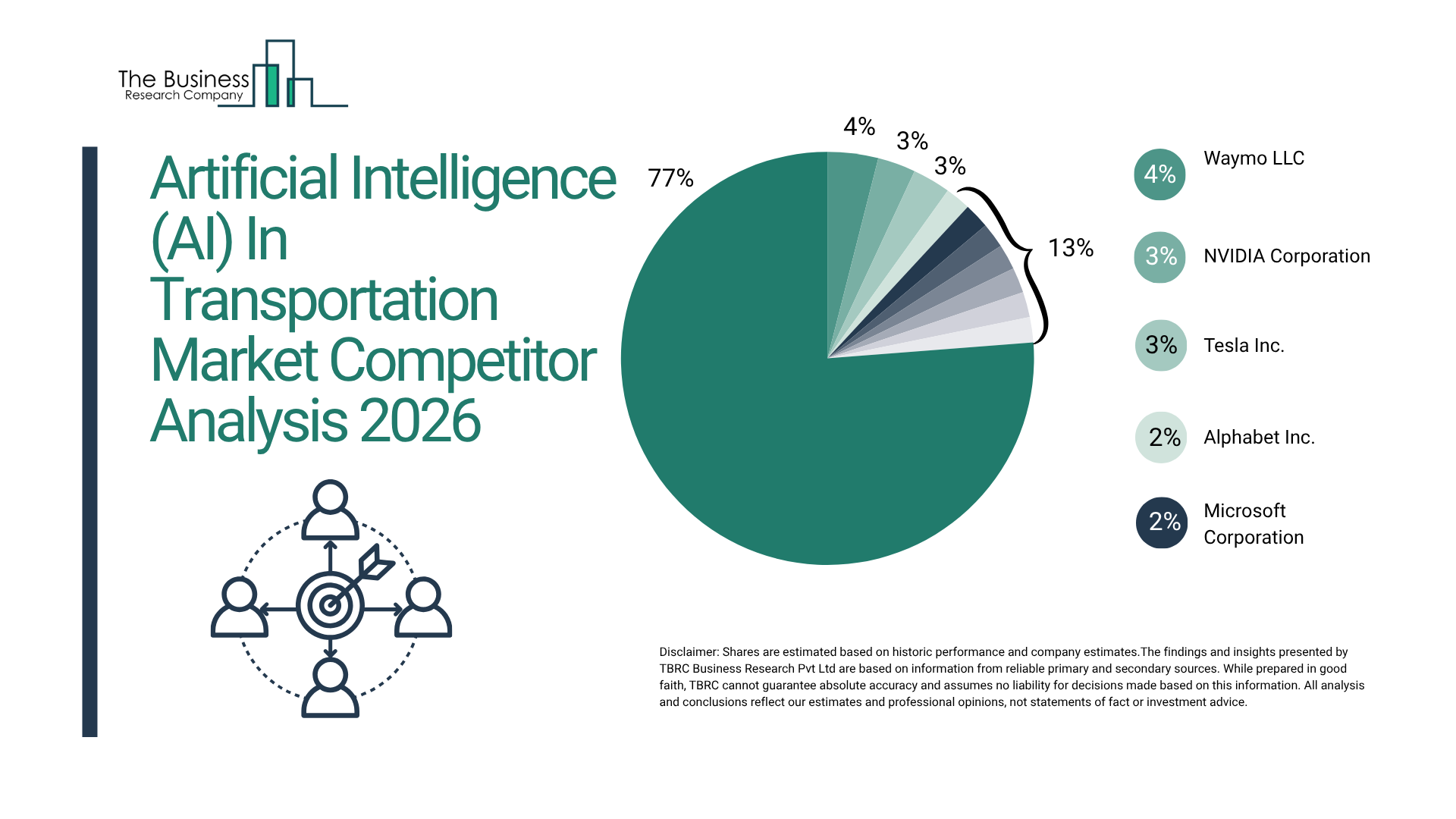
According to The Business Research Company, Waymo LLC held the top position in global AI in transportation sales for 2025, capturing a 4% share. Waymo’s autonomous driving and mobility division offers sophisticated self-driving systems, AI-enabled perception and decision-making technologies, and autonomous ride-hailing services that advance smart mobility, vehicle automation, and connected transportation.
Other key players in this sector include NVIDIA Corporation, Tesla Inc., Alphabet Inc., Microsoft Corporation, Robert Bosch GmbH, Mercedes-Benz Group AG, Aptiv plc, Continental AG, Intel Corporation, Siemens AG, Uber Technologies Inc., ZF Friedrichshafen AG, HERE Technologies, Magna International Inc., Aurora Innovation Inc., Valeo SA, Cisco Systems Inc., PACCAR Inc., IBM Corporation, Volvo AB, TomTom N.V., Daimler AG, TuSimple Holdings Inc., and PlusAI Inc.
Competitive Dynamics in the AI in Transportation Market
The AI in transportation market shows moderate fragmentation, with the top ten firms accounting for 23% of total revenues in 2025. This landscape features moderate to high entry barriers, including advanced AI development requirements, the need for large-scale data infrastructure, stringent transportation safety regulations, cybersecurity mandates, and the complexity of integrating autonomous and connected systems across diverse networks. Leading companies maintain strong market shares through sophisticated AI platforms, autonomous driving solutions, high-performance computing capabilities, and integrated mobility software backed by substantial research and development, partnerships with automotive OEMs, global technology ecosystems, and innovation in machine learning, computer vision, and sensor fusion. As demand for autonomous vehicles, intelligent traffic management, predictive analytics, and connected mobility grows, ongoing collaborations, technology integration, and geographic expansion will reinforce their positions.
Market Shares of Leading Companies in 2025
Waymo LLC led with a 4% share
NVIDIA Corporation held 3%
Tesla Inc. also held 3%
Alphabet Inc. accounted for 2%
Microsoft Corporation had 2%
Robert Bosch GmbH received 2%
Mercedes-Benz Group AG held 2%
Aptiv plc had 2%
Continental AG secured 2%
Intel Corporation also held 2%
Strategies for Sustained Leadership in AI Transportation
Top companies are focusing on advancing AI-driven transportation systems to enhance vehicle autonomy and road safety. They leverage machine learning to improve maintenance and fleet efficiency. Expansion of intelligent mobility solutions is aimed at strengthening connected infrastructure, while integration of computer vision technologies serves to boost navigation capabilities and accident prevention.
Key Suppliers and End Users in the Market
Major suppliers of raw materials and components for AI in transportation include NVIDIA Corporation, Intel Corporation, Qualcomm Incorporated, Advanced Micro Devices Inc., Texas Instruments Incorporated, Broadcom Inc., NXP Semiconductors N.V., STMicroelectronics N.V., Renesas Electronics Corporation, Infineon Technologies AG, Analog Devices Inc., Microchip Technology Incorporated, Samsung Electronics Co. Ltd., Sony Semiconductor Solutions Corporation, Toshiba Corporation, Panasonic Holdings Corporation, Hitachi Ltd., Siemens AG, Robert Bosch GmbH, Continental AG, ZF Friedrichshafen AG, Denso Corporation, Valeo S.A., Mobileye Global Inc., and Huawei Technologies Co. Ltd.
Key wholesalers and distributors consist of Arrow Electronics Inc., Avnet Inc., Ingram Micro Inc., Tech Data Corporation, Synnex Corporation, Future Electronics Inc., Mouser Electronics Inc., Digi-Key Electronics, RS Group plc, RS Components Limited, TTI Inc., Allied Electronics and Automation, Macnica Inc., EET Group A/S, Redington Limited, ALSO Holding AG, Esprinet S.p.A., ScanSource Inc., Exclusive Networks SA, Westcon Group, Bechtle AG, CDW Corporation, Insight Enterprises Inc., Mindware FZ LLC, and Logicom Public Limited.
Prominent end users of AI in transportation technologies include Tesla Inc., Waymo LLC, Uber Technologies Inc., Lyft Inc., Aurora Innovation Inc., Baidu Inc., Pony.ai Inc., Zoox Inc., Cruise LLC, Amazon Robotics LLC, DHL Supply Chain, FedEx Corporation, United Parcel Service Inc., DB Schenker AG, Deutsche Bahn AG, Toyota Motor Corporation, Ford Motor Company, General Motors Company, Volkswagen AG, BMW Group, Mercedes-Benz Group AG, Hyundai Motor Company, Nissan Motor Co. Ltd., Volvo Group, and Navistar International Corporation.
Hardware and Software Segments Poised for Significant Growth
The hardware and software divisions represent the largest growth opportunities within the AI in transportation market, expected to contribute more than $7 billion in additional value by 2030. Between 2025 and 2030, hardware is anticipated to grow by $2 billion and software by $5 billion. This expansion is fueled by increasing demand for AI-enabled sensors and edge computing devices, high-performance AI processors, in-vehicle computing systems, intelligent traffic surveillance, incident detection solutions, vehicle-to-everything (V2X) communication infrastructure, and the integration of AI into multimodal transportation. These advancements reflect a growing emphasis on safety, network efficiency, and data-driven mobility intelligence across transportation and smart mobility sectors.
New strategic additions in our 2026 market reports include market attractiveness scoring and analysis, total addressable market (TAM) analysis, company scoring matrix graphics and tables, Excel-based forecasting dashboards, market hotspots infographics, key technologies and future trend analysis, along with updated graphics and tables.
Learn More About The Business Research Company
The Business Research Company (www.thebusinessresearchcompany.com) is a leading market intelligence firm renowned for its expertise in company, market, and consumer research. We have published over 30,000+ reports across 27 industries and 60+ geographies. Our research is powered by 1,500,000 datasets, extensive secondary research, and exclusive insights from interviews with industry leaders.
We provide continuous and custom research services, offering a range of specialized packages tailored to your needs, including Market Entry Research Package, Competitor Tracking Package, Supplier & Distributor Package and much more.
Disclaimer: Please note that the findings, conclusions and recommendations that TBRC Business Research Pvt Ltd delivers are based on information gathered in good faith from both primary and secondary sources, whose accuracy we are not always in a position to guarantee. As such TBRC Business Research Pvt Ltd can accept no liability whatever for actions taken based on any information that may subsequently prove to be incorrect. Analysis and findings included in TBRC reports and presentations are our estimates, opinions and are not intended as statements of fact or investment guidance.
Contact Us:
The Business Research Company
Americas +1 310-496-7795
Europe +44 7882 955267
Asia & Others +44 7882 955267 & +91 8897263534
Email: marketing@tbrc.info
Follow Us On:
LinkedIn: https://in.linkedin.com/company/the-business-research-company
Oliver Guirdham
The Business Research Company
+44 7882 955267
Visit us on social media:
LinkedIn
Facebook
X
Legal Disclaimer:
EIN Presswire provides this news content “as is” without warranty of any kind. We do not accept any responsibility or liability
for the accuracy, content, images, videos, licenses, completeness, legality, or reliability of the information contained in this
article. If you have any complaints or copyright issues related to this article, kindly contact the author above.

Media gallery
