New American Biogas Council Report Finds More Opportunities to Put Wastewater Plants to Work
Nationwide survey finds new data on anaerobic digestion, with opportunities to manage more waste and expand energy
Press Release Disclaimer: This is a press release distributed through the XPR Media network. It has not been independently verified by our newsroom.

Nationwide survey finds new data on anaerobic digestion, with opportunities to manage more waste and expand energy production
WASHINGTON, DC, UNITED STATES, September 28, 2026 /EINPresswire.com/ — A new nationwide survey of U.S. wastewater facilities reveals opportunities to expand the production of renewable energy from wastewater, make greater use of existing digesters, and put more organic waste to productive use.
The American Biogas Council’s new report, Anaerobic Digestion at U.S. Water Resource Recovery Facilities, is the first comprehensive assessment of anaerobic digestion at wastewater facilities in more than a decade. Anaerobic digestion breaks down organic waste such as sewage sludge (or “biosolids”) to produce biogas that can be used to generate electricity and heat or processed into renewable natural gas. The 18-month study included more than 33,000 calls and 3,271 conversations with facility managers, operators and other key personnel.
The survey identified 1,213 wastewater resource recovery facilities using anaerobic digestion, representing about 24% of the roughly 5,000 facilities surveyed that treat at least one million gallons of wastewater per day.
A national picture of wastewater digestion
The report provides new data on where biogas is being captured at wastewater plants across the country and how facilities are using the energy it produces, including:
• More than 75% of facilities treating more than 30 million gallons per day use anaerobic digestion.
• About 50% of facilities treating 5 to 30 million gallons per day use digesters, while fewer than 30% of facilities treating less than five million gallons per day do.
• 103 facilities with digesters treat less than one million gallons per day, representing nearly 9% of all wastewater facilities with digesters.
• Anaerobic digestion has been part of U.S. wastewater treatment for more than a century. The earliest facility identified by the survey began operating in New York in 1914.
• 89% of the electricity generated from biogas at WRRFs is used on-site.
“America has over a thousand wastewater facilities managing organic waste. Our survey shows there are opportunities to do more — by expanding anaerobic digestion where it makes sense and getting more value from the digesters already in place,” said Patrick Serfass, Executive Director of the American Biogas Council.
Many wastewater plants are already producing energy, but opportunity remains untapped
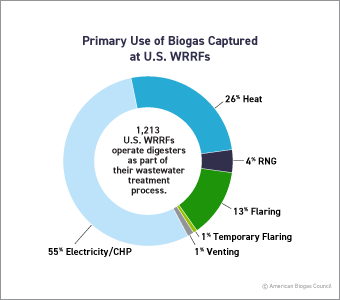
The survey also found that wastewater facilities with anaerobic digesters currently capture about 100.8 billion cubic feet of biogas each year – enough energy to generate electricity for about 1.1 million U.S. homes. More than 80% use the biogas they produce for energy onsite, with 55% using it to generate electricity or combined heat and power and another 26% using it for heat.
The report also identifies the potential to capture an additional 70 billion cubic feet annually, bringing the total to nearly 172 billion cubic feet – enough to generate electricity for about 1.9 million homes.
Co-digestion can convert more waste into renewable energy
There is also an opportunity to make better use of the digesters already operating at wastewater facilities. Some facilities accept organic material from outside sources – a practice known as co-digestion. Food processing waste, post-consumer food scraps and other organic materials can be added to wastewater solids in an existing digester, producing additional biogas and putting some of the 24 million tons of food waste currently landfilled each year to productive use. Today, 139 wastewater facilities accept outside organic material, including food waste and fats, oils, and grease.
Explore the full report, available to download here. ABC also offers Wastewater Fast Facts, additional graphs, biogas project profiles, and more in the American Biogas Council Newsroom.
About the American Biogas Council
The American Biogas Council is the voice of the U.S. biogas industry, representing all companies working to recycle organic waste into clean, locally made energy and fertilizer. Biogas capture systems recycle waste, food scraps, manure, and wastewater, keeping communities safe and clean, and supporting local economies. The ABC’s mission is to maximize the economic and environmental benefits of biogas while advancing sustainable solutions for energy, agriculture, and waste management. Learn more at americanbiogascouncil.org, on X @ambiogascouncil, Facebook, and LinkedIn.
Melissa Bailey
American Biogas Council
+1 310-465-5647
melissa@americanbiogascouncil.org
Visit us on social media:
LinkedIn
Facebook
X
Legal Disclaimer:
EIN Presswire provides this news content “as is” without warranty of any kind. We do not accept any responsibility or liability
for the accuracy, content, images, videos, licenses, completeness, legality, or reliability of the information contained in this
article. If you have any complaints or copyright issues related to this article, kindly contact the author above.

Media gallery